


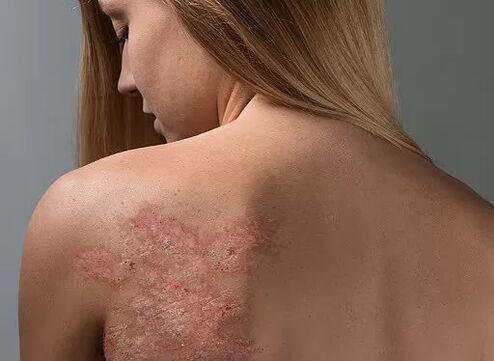
In the last decade, doctors have noted a sharp increase in psoriasis.The disease is associated with internal inflammation, it is a chronic process and does not ensure complete recovery.Treatment and prevention of complications include the use of drugs, diet and folk remedies on a natural basis.
The nature and history of psoriasis
The first records of skin disease symptoms were found in the annals of ancient Egyptian and Indian healers.It was described in detail by Hippocrates, who gave the name "psora" to red plaques and papules on the body.In the Middle Ages, it was considered a dangerous type of leprosy for a long time, so patients hid the inflammation to avoid forced treatment.
Psoriasis was first identified as a separate disease in 1841 by the German dermatologist and scientist Ferdinand von Hebr.He conducted extensive research on epithelial sampling and described in detail all stages and types of the inflammatory process.His successor, Jean Louis Alibert, attributed the disease to a specific form of arthritis.
Detailed study of psoriasis began in the 20th century.With the help of better equipment and optics, doctors learned that the processes of skin regeneration and peeling during the disease are accelerated 8-10 times.They separated the pathology from dermatitis and proved its autoimmune nature.
In recent years, it has been possible to identify the main factors that increase the risk of psoriasis.But doctors continue to search for the causes of the disease;effects of immunity and heredity are considered.To date, hundreds of drugs have been developed for treatment, but no method relieves the patient of the problem forever.
The main causes of psoriasis
In a healthy person, the process of renewal of the upper layer of the dermis takes 21-30 days.During this time, the cell is formed, grows, performs basic functions and dies, making room for a new one.In psoriasis, under the influence of negative factors, the process accelerates several times, no more than 5-6 days.
Most dermatologists believe that the main cause of the disease is autoimmune disorders.For unknown reasons, a person's immune system begins to attack their own skin cells, which provokes an inflammatory process.They do not have time to mature and break off from the deeper layers to form itchy plaques.
Among the main reasons and factors that lead to the development of the disease:
- decreased immunity;
- frequent colds, ARVI or flu;
- hormonal imbalance;
- pathologies of the thyroid gland;
- permanent hypothermia;
- working with chemicals;
- psychological problems, stress, disorders;
- drug or alcohol use.
Recent scientific developments suggest several hypotheses about the causes of the disease.They are based on observations of different patient groups:
- hidden allergies to foods, drugs or environmental factors;
- infections and foci of inflammation in internal organs;
- disruption of metabolic processes affecting tissue regeneration;
- the presence of parasites;
- psychosomatics.
Psoriasis is often inherited.If both parents have the gene, the risk of encountering the pathology increases to 50%.In most cases, the first manifestations of the disease are observed during puberty and during the final formation of the body - from 15 to 20 years.
Many patients manage to avoid painful manifestations with the help of diet and healthy lifestyle.However, doctors identify several factors that can lead to exacerbations and frequent relapses:
- smoking;
- infectious skin diseases;
- side effects of certain medications;
- complications after vaccination;
- to darken;
- stressful situations.
In most cases, the occurrence of psoriasis is a combination of several factors.It worsens after suffering from bronchitis or tonsillitis, for which antibiotics are used.It is always associated with a decrease in immunity and weakening of the body.
Dangerous complications of psoriasis
Itching, burning and plaques on the skin are not the only manifestations.The inflammatory process can affect internal organs and systems, and can spread to the joints.The level of toxins in the blood constantly increases, disrupting metabolic processes.
The main problem of advanced psoriasis is the development of arthritis.In 15-20% of patients, it is diagnosed at various stages and often occurs with relapses and painful inflammation of the joints.Often the process involves fingers and toes, ankles, knees and hip joints.
Other complications of psoriasis include:
- erythroderma with large areas of skin lesions;
- decreased visual acuity;
- expansion of the ventricles of the heart;
- kidney diseases;
- chronic intestinal disorder.
With psoriasis, the risk of severe depression and mental pathologies increases 2-3 times.The disease is non-transmissible and non-contagious, but people with skin defects often avoid personal relationships and are ashamed of their bodies.They deliberately refuse intimate life and visit interesting places.Prejudice to the problem minimizes the circle of friends.
Main symptoms and signs of psoriasis
An experienced dermatologist can easily distinguish the manifestations of the disease from other forms of dermatitis.A few more rash-like spots appear on the body.They rapidly increase in diameter, reach 7-8 cm and begin to peel off.If psoriasis is not treated, the inflamed areas cover 50-60% of the body.
The following signs help distinguish psoriasis plaques from lichen or allergies:
- They have clear edges, thicken slightly and rise above the skin, causing slight swelling and redness.The scales are light, almost silver in color.
- Abraded particles are easily scraped off the surface, leaving the surface coated with wax.
- After removing the inflamed scales, a thin red layer of new cells glistens in the light.
- When you try to peel off the film, drops of blood appear (Auspitz phenomenon).
These are the main symptoms of psoriasis that help to make a self-diagnosis.The first manifestations are observed at the site of friction with clothing after abrasions or thermal burns that resemble non-healing wounds.However, there are several options for placing a papule on the patient's body:
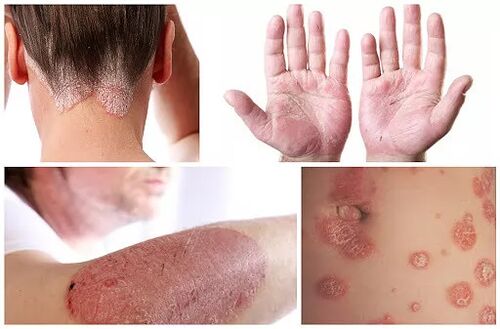
- in my armsSmall lesions can be localized on the fingers and can cover the elbows with crusts.In rare cases or in advanced forms, the process affects the forearm.
- Above the head.The general form is diagnosed when particles and crusts appear on the scalp.The inflammation starts at the back of the head, gradually moves behind the ears, accompanied by a burning sensation and abundant dandruff reminiscent of the crown.
- In the body.Small plates in the shape of a teardrop abundantly cover the abdomen, thighs and back.The problem often occurs after treating infections with antibiotics.
- On palms and feet.Palmoplantar psoriasis starts with a few small plaques, but quickly turns into large areas covered with whitish skin.Sometimes itchy crusts appear only between the fingers.
- On the face.A rare form localized on the thin skin of the eyelids, around the lips with rashes on the cheeks.
Recently, the number of children who develop psoriasis before puberty has increased.In babies, the first papules are hidden in the folds of the skin in the groin, armpits and neck.They itch, cause discomfort and loss of appetite.Parents often mistake them for the manifestation of atopic dermatitis.
Types and forms of the disease
Psoriasis is classified separately according to its symptoms and characteristic manifestations.Classification by form helps to correctly identify the main cause of the disease and choose a treatment method:
- Plain, board-like, or vulgar.The classic version appears on the skin with a large number of plates.They are covered in silvery scales, very raised, itchy and may bleed when scratched.They are often combined with a large formation on the back, abdomen or legs.It is characterized by regular relapses and joint complications.
- In the form of dots or drops.There are many small dots on the body, no more than 1.5 cm in diameter.They look like rashes and are rarely localized on the face and hands.When rubbed with seams, the dressing often peels off, leaving open, inflamed skin infected with secondary infection.
- Pustules.A complex form in which up to 30-50% of the body is affected.Exacerbation is accompanied by enlarged lymph nodes, high temperature, exacerbation of internal diseases, and requires medical assistance in a hospital setting.It is divided into local and generalized Tsumbusha type.
- Exudative.One of the heaviest forms.It occurs in patients with endocrine pathology and develops against the background of diabetes.In addition to the bark, plaques secrete a large amount of inflammatory fluid.They are saturated with exudate, turn into a dense crust, and when touched or treated, they cause severe pain to a person.
- Parapsoriasis or Broca's disease.It has similar symptoms, but the plaques are more reminiscent of eczema spots, do not have a film effect or waxy sheen, and do not leave red drops after removal.It can be accompanied by fever, weakness and deterioration of health.
- Reverse or vice versa.A rare form is diagnosed in 1% of people.One of the manifestations is dark pigmentation in the axillary and inguinal folds, which does not cause intensive peeling at the initial stage.
As the disease progresses, seborrheic psoriasis may join the above.This form is diagnosed when itchy spots appear on the scalp.It develops quickly and spreads to the forehead, affecting the face.Patients use a special shampoo and mistake it for ordinary seborrhea.However, during visual inspection, there is no greasy shine and abundant sebum secretions, the skin is dry, the scales shine in the light.
Separately, doctors distinguish nail psoriasis or onychodystrophy.It resembles the vulgar form and often occurs with relapses.It occurs in 90% of patients with psoriatic arthritis.It occurs in only 7% of children, but it is difficult to treat.Symptoms include plate tearing, white spots, warping, and severe delamination.
Stages of psoriasis
In clinical practice, there are several stages of the disease.They differ in the severity of symptoms, manifestations and the nature of the course.Separately, many experts describe the first, which occurs in many patients with latent inflammation that resembles ordinary dermatitis or lichen.
In the initial or early stage, the rash is almost invisible.Sometimes there is a slight peeling on the elbows or legs, which does not cause concern.After applying a moisturizer or lotion, the burning sensation subsides.The spots are small in diameter and do not cause concern.
When making a diagnosis, the following classification of psoriasis stages is used:
- Acute or progressive.Spots grow noticeably and are covered with dry particles of the epidermis.The patient is worried about severe itching, burning, irritation and swelling of the skin at the site of the rash.A red border appears around the boards.
- Stationary stage.New formations do not appear, but the disease progresses, adversely affecting the joints and internal organs.Unpleasant sensations intensify, plaques merge into large spots on the body, appear on the head, nails and feet.The skin looks inflamed, peeling and cell death does not stop.
- Regression or resolution.Symptoms of psoriasis gradually decrease and disappear.Red spots dissolve, whitish areas remain on the skin.The patient returns to a normal lifestyle.
To choose a treatment method, it is necessary to divide into stages.The most effective and powerful drugs are used in stationary form, when there is the greatest danger of damage to internal organs, systems and joints.Therefore, the task of doctors is to quickly eliminate the exacerbation and achieve complete elimination of symptoms.The disease cannot be cured, so it is important to strive for long-term regression.
Treatment methods for psoriasis
Doctors recommend to start therapy at the first signs of exacerbation and prevent the disease from progressing to complications.At the initial stage, you can use non-hormonal agents, you can complete the course with a special diet and folk recipes.It is important to exclude factors that provoke a new cycle of psoriasis: stress, smoking, overwork, lack of sleep.
Treating psoriasis at any stage is a difficult task.Often, the patient, together with the doctor, must go through many ointments, creams and formulas in search of an effective therapy.It is not enough to quickly eliminate the external manifestations of the disease: it is necessary to ensure the absence of internal inflammations, damage to the joints and prevent the development of arthritis.
Drug therapy
Treatment of any form of psoriasis begins with the use of external means.They have different active substances, differ in composition and principle of effect on the epidermis.
Preparations contain vitamins, minerals and oils that relieve anxiety and improve blood circulation in the capillaries.Zinc and phenolic acid additionally protect against bacteria, prevent secondary infections and dry moist areas.
If the lesions are severe and the spots grow, doctors prescribe hormonal ointments.Medicines for local treatment are selected individually after examination, taking into account the patient's age, health characteristics and possible contraindications.
Ointments and creams contain synthetic hormones that affect skin receptors and slow down the damaged regeneration process.The inflammation gradually decreases, the cells are produced more slowly, and the film-covered areas heal.Medicines may contain glucocorticosteroids.But they have a number of serious drawbacks:
- Many hormonal drugs are contraindicated for the treatment of children under 2 years of age, during pregnancy and lactation.
- It is necessary to strictly adhere to the dosage and follow the instructions.
- They are chosen at a high price.
The use of hormonal ointments is allowed only under the supervision of a doctor.Active components can penetrate the blood, affect the adrenal cortex and suppress the production of cortisol.In case of overdose or long-term use of drugs, treatment should be stopped gradually with daily dose reduction.
During seasonal exacerbation of psoriasis, drugs and vitamin complexes that strengthen immunity can be used.They stimulate the body from the inside, eliminate dysbacteriosis and vitamin deficiency, accelerate the healing of the skin.The main task of such compositions:
- removal of toxins;
- joint tissue support;
- improving well-being;
- acceleration of metabolism;
- cleansing the liver.
Means that increase the effect of the diet, trigger the cleansing of tissues, intestines and support the immune defense are recommended for psoriasis.Depending on the form of the disease, they are used at a progressive stage or to prevent relapse in the form of injections or tablets.
Psoriasis often occurs in stressful situations.To eliminate the provoking factor, doctors choose immunosuppressants.They normalize sleep, reduce irritation and anxiety, and stop the inflammatory process.
Immunosuppressants relieve tension and soothe irritated skin receptors.They relieve burning and itching and additionally have an antirheumatic effect.They bind and remove substances that affect the joints, reduce pain and intensity of sensations during exacerbations.They are not used at home and require strict dosage.
Sorbents are distinguished among the traditional means of treatment in the treatment of psoriasis.These are special drugs that absorb toxins and decomposition products that are in large quantities in the blood and intestines during an exacerbation.It reduces the risk of developing psoriatic arthritis, digestive disorders and accelerates the clearing of skin plaques.
The advantage of sorbents is that they are safe for the body, so they can be used in the medical treatment of diseases in children.They are used in the removal of biological agents and hormonal creams and reduce the concentration of synthetic hormones in the blood.
Chinese remedies for psoriasis
Chinese herbal preparations have proven themselves well in the complex treatment of inflammation.Doctors recommend using them after a course of hormonal ointments for detoxification and recovery.The highest quality according to patient reviews:
- Lotion containing fluoride, phenol, acetic acid, borneol and plant extracts.
- A Chinese ointment that quickly penetrates the skin without hormones, saturating it with extracts of blackthorn, lichen, rhubarb and fulin mushrooms.
- A hormonal agent prescribed during the acute period to reduce inflammation, peeling and itching.It contains glucocorticosteroid, petrolatum, stearin, menthol oil.It is allowed for the treatment of facial skin.
- Inexpensive ointment based on natural raw materials.It consists of extracts of mint, echinacea, clover with the addition of scorpion venom.
- Vulgar is a popular remedy for the treatment of psoriasis.Due to the composition of turmeric, sandalwood oil, neem, tulsi, it relieves itching.
- Sulfur soap containing aloe extract, olive and palm oils moisturizes, restores lipid balance and heals wounds.
- Ointment containing Sophora, holly, cork, mulberry bark and antiseptic extracts.It is used twice a day for exacerbation.
- Enriched with Sophora japonica juice and ash tree root, this safe cream from China relieves dryness, flaking and itching.It can be applied to the face and scalp.
Before the course of treatment with drugs from China, you must undergo an allergy test: in high concentrations, some plant components increase irritation, aggravation and discomfort.
Traditional methods
There are different ways to treat psoriasis.After the acute process is eliminated, therapy can be completed with folk remedies.In case of exacerbation, medical solid fat recipes are often used:
- Mix liquid honey and oil in equal proportions, add ground oak bark and one raw egg.The resulting mixture is applied to the body 2 times a day.
- In a clean bowl, mix 2 tablespoons of oil and baby cream, add a little sea urchin oil.Treat inflamed areas with the product in the morning and evening.
To treat psoriasis, you can take a bath with the addition of useful substances: sodium bicarbonate, sea salt, oat broth, turpentine.The last component based on pine resin eliminates inflammation, improves blood circulation, soothes and tones the skin.Improvement requires up to 15 procedures with an interval of 1-2 days.
Alternative methods
In addition to drugs, the patient may be offered light treatment or photochemotherapy PUVA.In 90-95% of cases, it is possible to significantly improve the condition of the skin and stop the process.Therapy is used in the following forms:
- exudative;
- vulgar;
- palmoplantar.
The use of PUVA is effective for scalp lesions.Irradiation with light waves is carried out in a course of 5-6 procedures at a low frequency that is safe for the body.Among the proven alternative methods for psoriasis:
- selective phototherapy;
- narrow wave;
- mud treatment;
- plasmapheresis.
To reduce inflamed areas, mud applied in the form of applications or taken in the bath is recommended.The most effective compounds are extracted on the shores of the Dead Sea and in the resorts of Kuyalnik.They contain minerals that soothe and restore the skin.
Prevention of psoriasis
An important way to prevent exacerbation and relapse of the disease is proper nutrition.The Pegano diet, specially prepared by a doctor, helps to reduce the level of allergens, eliminate intoxication and prevent dysbacteriosis.Its main principles:
- Up to 70-80% of the menu should consist of alkaline-forming foods (fruits and vegetables).
- Only 20-30% of the diet can consist of foods that increase acidity (meat, grains, fish, whole milk).
- Fatty and carbohydrate foods, coffee, sweet carbonated drinks and alcohol are completely excluded.
- All food should be steamed, boiled or cooked without oil.
- Eat in small portions to avoid overloading the intestines.
It is important to stop smoking and drinking alcohol to prevent psoriasis.It is necessary to monitor daily bowel cleansing, drink purer water without gas and additives.
Answers to frequently asked questions about psoriasis
Can you get psoriasis?
This is the first misconception that negatively affects communication with patients.In fact, the disease is only related to the functioning of the immune system and does not have viruses that are transmitted through contact.You can safely handle the patient's skin, put on clothes or shoes.
Is it possible to swim during exacerbation?
Doctors recommend taking daily baths or hot showers, which relieve discomfort and burning sensation and reduce peeling.The procedure can be completed by bathing in sea salt, starch solution or treating the plaques with mud applications.
Is it possible to cure psoriasis completely?
To date, no treatment methods for psoriasis have been found that can completely save the patient from the problem.It is a chronic and incurable disease that often occurs with relapses and requires constant prevention.With proper nutrition, diet and healthy lifestyle, it is possible to reduce the number of exacerbations and reduce the severity of the course.
The causes and characteristics of psoriasis are actively studied by doctors in different countries.Many treatments have been developed that give good results, but do not guarantee complete recovery.In case of exacerbation, it is necessary to combine drug treatment, traditional medicine, detoxification and follow a strict diet.